
Suction Cup Raman Probe
Raman Spectroscopy Through Glass and Acrylic
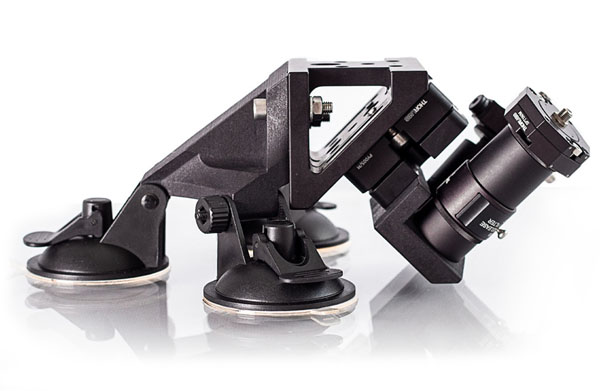
The IS-Instruments Suction Cup Raman Probe enables non-contact spectroscopic measurements through glass, acrylic and other suitable transparent materials, allowing samples to be analysed without direct access.
Using a biaxial optical configuration, the probe is designed to minimise interference from the intervening window material, making it particularly useful for measurements through thick optical windows that can present challenges for conventional Raman systems.
Originally developed to support non-contact Raman measurements through viewing windows in nuclear gloveboxes, the Suction Cup Raman Probe has subsequently been adapted for pharmaceutical freeze-drying research. Its biaxial optical configuration enables measurements through suitable transparent barriers, including glass and acrylic, without requiring direct access to the sample.
With a 100 mm focal length and compatibility with IS-Instruments’ high-étendue spectrometers (HES), the probe supports Raman measurements across a range of research and industrial applications.

Product Specifications
Through-window Raman measurements for enclosed environments
The Suction Cup Raman Probe provides a means of collecting Raman spectra from samples located behind transparent barriers, without opening or modifying the enclosure.
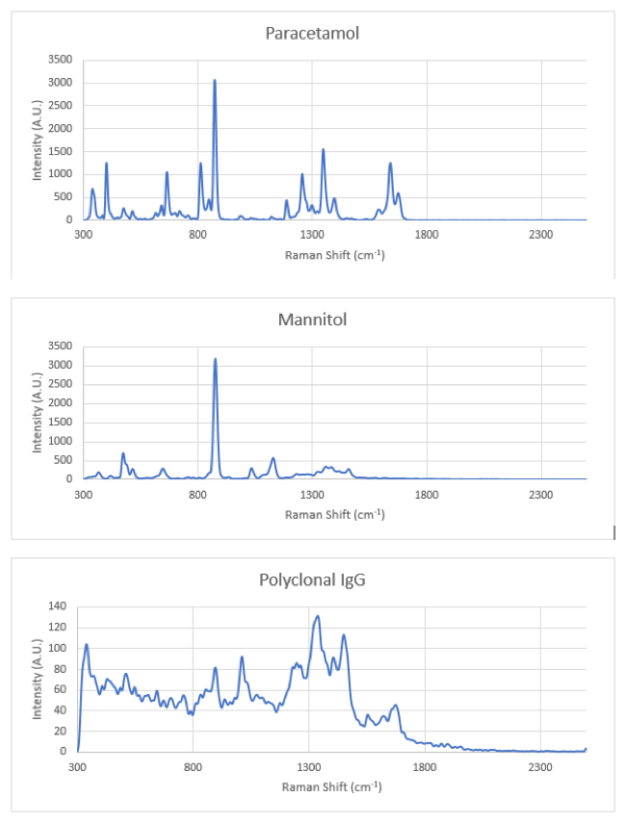
Raman spectra of paracetamol, mannitol and polyclonal IgG were collected through a 25 mm acrylic window and glass sample vial, demonstrating the probe’s ability to acquire spectral information through multiple transparent barriers (see below).
Features & Benefits:
- Non-invasive measurements: Enables Raman analysis through suitable transparent barriers, including glass and acrylic, without direct access to the sample or disruption of the enclosed environment.
- Reduced spectral interference: Biaxial optical configuration designed to minimise interference from window materials during through-window measurements.
- Flexible installation: Suction cup mounting allows external positioning on suitable viewing windows, including those used in pharmaceutical freeze-dryers and laboratory enclosures.
- Process monitoring potential: Supports research into real-time monitoring of material changes during pharmaceutical lyophilisation, including crystallinity and drying progression.
- Improved process development: Could help reduce the need for repeated experimental cycles by providing additional analytical information during freeze-drying.
- Greater manufacturing efficiency: Improved process understanding could contribute to more efficient freeze-drying cycles, reducing energy consumption and associated environmental impacts.
- Broader applications: Originally developed for nuclear glovebox monitoring, the technology has subsequently been adapted for pharmaceutical research and other applications requiring measurements through transparent barriers.
| Feature | Detail |
|---|---|
| Raman operating λ | 785 nm |
| Configuration | Biaxial |
| Standoff distance (from 100mm diameter window) | ~ 1000 mm |
| Laser fibre connection | FC/PC |
| Spectrometer fibre connection | SMA |
| Dimensions | L: 270 mm W: 200 mm H: 100 mm |
| Mass | 0.94 kg |
Applications include:
- Pharmaceutical freeze-drying and lyophilisation research
- Through-window process monitoring
- Chemical measurements within fume cupboards
- Measurements through glovebox windows
- Research involving enclosed or inaccessible samples